
TIME:2026-03-24 10:16:47
Understanding Fire Retardant Standards for UPVC Profiles in Europe
For architects, construction managers, and procurement officers operating in the European market, building material compliance is non-negotiable. Among the most heavily scrutinized materials are plastics used in construction, including customized UPVC extrusion profiles and temporary site barriers.
Because UPVC (Unplasticized Polyvinyl Chloride) is inherently flame-retardant due to its high chlorine content, it is a preferred material for many applications. However, to pass strict European building codes, simply being "flame retardant" isn't enough. Suppliers and contractors must speak the language of exact testing standards.
Here is a comprehensive guide to understanding European fire-retardant standards for UPVC profiles and what you need to look for when sourcing your materials.
The Benchmark: EN 13501-1 standard
In Europe, the reaction to fire of construction products is governed by the EN 13501-1 standard. This classification system replaced the older national standards (such as the German DIN 4102 or British BS 476) to create a unified framework across the European Union.
The EN 13501-1 standard evaluates materials based on three critical criteria:
1. Fire Behavior (Euro class)
This measures how much a material contributes to the spread of a fire. The ratings range from A1 (non-combustible, like concrete) down to F (easily flammable).
High-Quality UPVC: Premium rigid UPVC profiles typically achieve a Class B or Class C rating. This means they are combustible but have a very limited contribution to fire. They will self-extinguish once the primary flame source is removed.
2. Smoke Production (s)
Smoke inhalation is often the greatest hazard during a building fire. The standard measures smoke opacity and the speed of emission:
s1: Little or no smoke production.
s2: Medium smoke production.
s3: Heavy smoke production.

3. Flaming Droplets (d)
This measures whether burning droplets fall from the material, which could spread the fire to lower levels:
d0: No flaming droplets.
d1: Some flaming droplets that extinguish quickly.
d2: Substantial flaming droplets.
The Ideal Classification: A high-performing UPVC profile designed for rigorous European applications will often target a classification like B-s3, d0 (Very limited contribution to fire, standard smoke, no flaming droplets).
Why This Matters for Construction and Hoarding Fencing
The application of the product dictates the stringency of the fire rating required. For internal architectural decorations, smoke emission (s-rating) is heavily scrutinized.
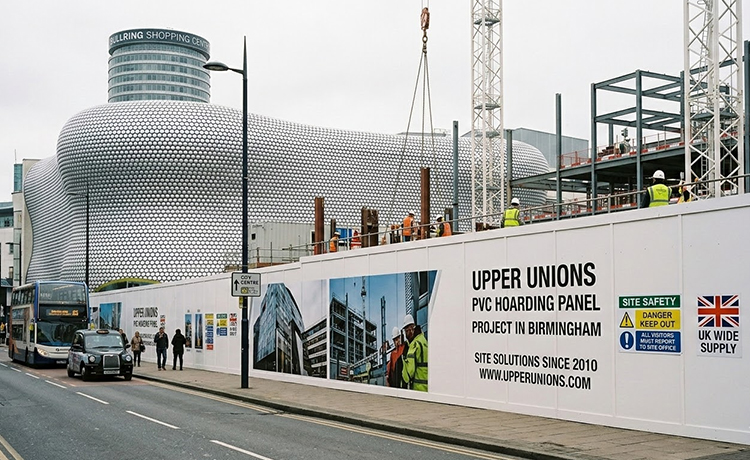
However, for external and temporary applications, structural integrity and preventing fire spread take precedence. For example, when evaluating large-format site barriers such as a 750mm uPVC hoarding fence, project managers must verify that the technical data sheet explicitly lists the product's reaction-to-fire classification. Ensuring that the formulation prevents flaming droplets (d0) is crucial for securing site perimeters without introducing new fire hazards to adjacent public walkways or equipment.
How Superior Formulations Achieve Compliance
Not all UPVC extrusions are created equal. Achieving a stable Class B rating requires precise compound formulations.
At Upper Unions New Material, our R&D team meticulously engineers our UPVC compounds. While the natural chlorine in PVC provides a baseline of fire resistance, we utilize advanced flame-retardant additives and stabilizers. During the extrusion process, the homogeneous blending of these additives ensures that the fire-retardant properties are consistent throughout the entire thickness of the profile, not just on the surface.
Sourcing with Confidence
When sourcing UPVC profiles or hoarding fencing for the European market, always ask your manufacturer for transparency. Relying on outdated claims or vague "fire-proof" marketing can lead to catastrophic compliance failures on-site.
Partnering with an experienced extrusion factory ensures that your products are backed by robust quality control, modern co-extrusion technology, and formulations that meet the exact requirements of EN 13501-1.
Ready to upgrade your material sourcing? Contact Upper Unions today to request a quote or ask for the detailed technical data sheets of our highly compliant UPVC profiles and hoarding fence panels.
